
Why It Works
duiduidui! adapts to you from the very first card: no placement tests, no forced tutorials, no one-size-fits-all curriculum. This page explains the reasoning in plain English. When you want the full derivation, the mathematics is published too.
Start Learning Immediately
Most language apps make you sit through a placement test, or start you from zero no matter what you already know. duiduidui! takes a different approach: just start reviewing, and the app figures out your level as you go.
Every card you review teaches the system about you. Get a card right and the app learns not just that you know that word, but something about the characters inside it. Get one wrong and the model adjusts, gently filling in the gaps. Within a few dozen reviews, duiduidui! has a calibrated picture of your skill and starts serving content matched to exactly where you are.
Two Layers of Intelligence
Traditional flashcard apps use spaced repetition: show a card, wait a while, show it again. It works, but it's blunt. It doesn't know when you're overwhelmed, and it treats every card as an island. duiduidui! runs two models simultaneously, and both go further.
Your knowledge of each card is tracked with Bayesian statistics. Every character, word, and phrase has its own proficiency estimate, and the system knows the difference between "never seen this before" and "reviewed fifty times and still tricky." Crucially, it also tracks how confident it is in each estimate. Those are different situations that call for different strategies.
Your overall skill level is tracked using Item Response Theory, the same mathematical framework behind standardized testing. The estimate comes with an honest confidence interval that narrows as evidence accumulates and re-widens when your performance surprises the model. That's how an already-skilled learner gets calibrated in a few dozen reviews instead of grinding up from zero.
The two layers work together: your skill level guides which new content to introduce, and your per-card knowledge determines what to review and when.
Language Is Compositional. Your Learning Should Be Too.
Every language builds meaning from smaller pieces. Chinese just wears that structure on its sleeve: characters combine into words, words into phrases, and the building blocks stay visible at every level. The character 好 (hǎo, good) joins with 吃 (chī, eat) to make 好吃 (hǎochī, delicious). Learn the pieces, and the compounds start making sense.
duiduidui! models that hierarchy explicitly. When you master a phrase, the system propagates evidence down to every character inside it. When you learn new characters, it looks ahead to the words and phrases you're now ready to tackle. Every review does double duty.
That inferred knowledge is held to a careful standard. Seeing a character inside phrases you know raises the system's belief that you know it, enough to stop drilling it like a stranger, but never enough confidence to call it mastered. Only a direct review can do that. The result is a middle "provisionally known" state: a fast learner isn't forced to grind through characters they clearly already recognize, while a single related slip-up instantly brings a shaky one back for confirmation.
Never Overwhelmed
Information overload is the silent killer of language learning. Most apps let you add cards until the review pile buries you, then blame you for not keeping up.
duiduidui! measures your cognitive load in real time: an estimate of how much you're actually juggling, built from how uncertain each active card is, how close it sits to your skill level, and how far along you are in mastering it. As a beginner, the app keeps your active set small (around 10 cards) so you can build a foundation. As your skills grow, so does your capacity; an intermediate learner might comfortably carry 100. The system throttles new material when you're near capacity and opens up when you have room, automatically.
Every Card Is Chosen for a Reason
Choosing what to show you next is the most important decision the app makes. Rather than a simple schedule, the system weighs every candidate card across several dimensions:
- Information value: how much will this card teach the system about you? Cards near the boundary of your knowledge are the most informative.
- Learning value: how much will this card improve your Chinese? Cards in your optimal challenge zone, neither trivial nor hopeless, maximize learning.
- Cognitive fit: do you have the bandwidth for this right now? Near capacity, reinforcement beats novelty.
- Compositional readiness: do you know enough of the pieces to have a fighting chance? You'll never be shown a four-character phrase when you haven't seen any of its characters.
The weighting shifts as you go. Early on, the system prioritizes figuring out what you already know; as uncertainty shrinks, it shifts toward optimizing learning. The transition happens gradually, card by card, and you never notice it.
A Difficulty Ladder Built Into the Language
Every item in the dictionary has a difficulty score. The foundational characters were individually curated against a written scoring rubric, whose guiding question is what learning each character lets you do that you couldn't do before; the difficulty of words and phrases is then computed from their parts (harder pieces make harder wholes, though the relationship isn't simply additive). And where the language itself breaks compositionality, the score gets a curated correction: words whose meaning you can't guess from their characters get pushed later, and survival words like 学生 (xuéshēng, student), which you need long before you can read its parts, get pulled earlier. About one word in seven carries such an override; the rest stand on the computed score.
This creates an emergent curriculum: characters build from simplest to most complex, radicals appear once you've seen enough characters to recognize their patterns, and words and phrases naturally follow their components. You never have to wonder what to study next. The ladder is built into the content itself.
Collections: Your Path, Your Pace
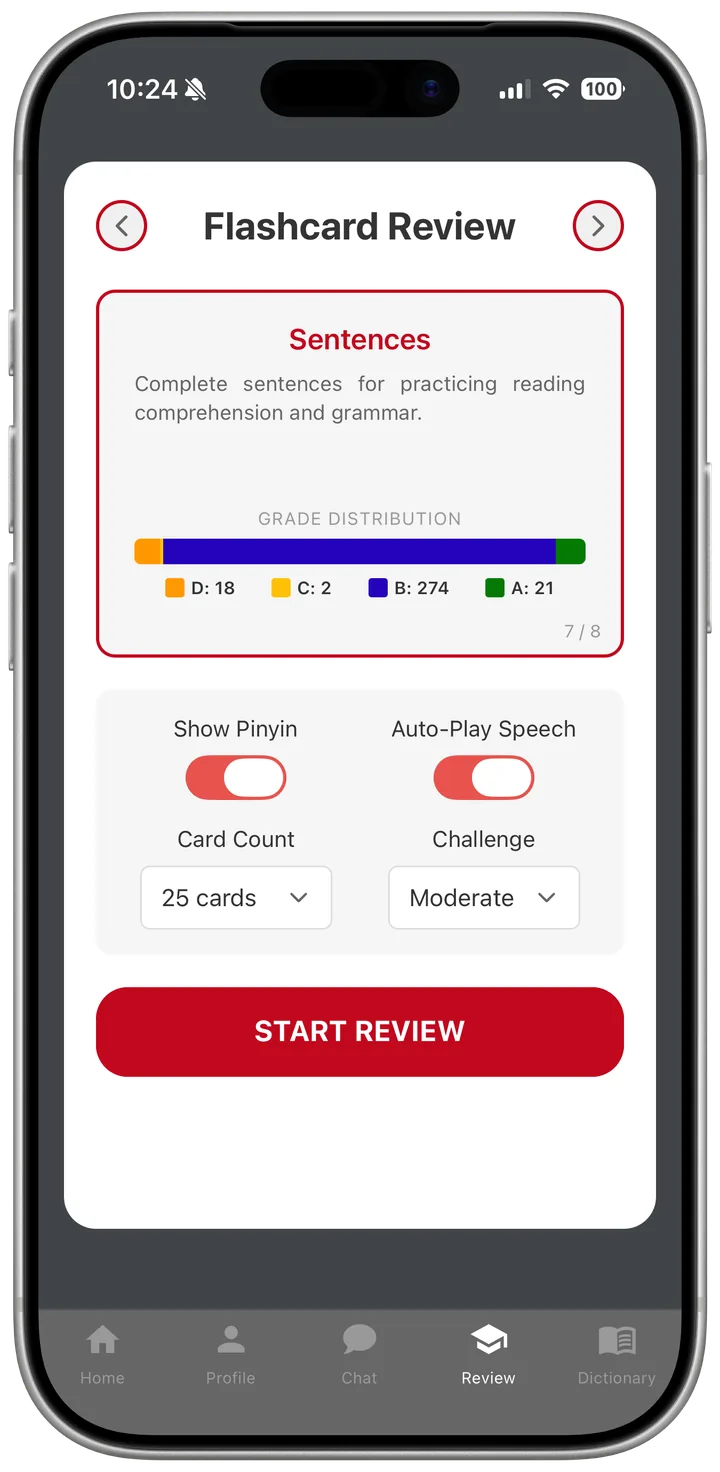
Rather than locking you into a rigid course, duiduidui! offers Collections: curated pathways you can browse, pick up, and switch between freely. Start with "First 100 Characters," explore "Food Vocabulary" before a trip, or jump into "HSK3" when an exam looms.
Every card can belong to many Collections at once, so reviewing a food-related character in "First 100 Characters" also advances your progress in "Food Vocabulary." You're always moving forward on several fronts, even when you're focused on one.
Built for Real Fluency
duiduidui! isn't about memorizing isolated vocabulary lists. It's about building a web of interconnected knowledge: the kind that lets you read a menu, follow a conversation, or decode a word you've never seen because you already know its parts. Every feature described on this page serves one goal: helping you actually learn Chinese, not just feel like you're learning.
And none of it is a black box. Every model on this page, from the Bayesian card estimates to the cognitive load formula, is written up in full on the mathematics page. We think it holds up to scrutiny, and we'd rather show you than ask you to trust us.